American Soldier by General Tommy R. Franks
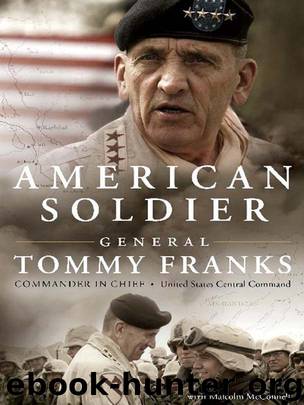
Author:General Tommy R. Franks
Language: eng
Format: epub
Publisher: HarperCollins
THE TEN DAYS FROM HELL ENDED ON FRIDAY, OCTOBER 19.
Near midnight, Afghan time—early afternoon in Tampa— John Mulholland inserted the first Special Forces A-Team into General Dostum’s mud-brick village headquarters south of Mazar-e Sharif. The 160th SOAR MH-47s that had been trying for several nights to lift the team—ODA 595—through the mountains had finally succeeded. We now had a twelve-man highly skilled Green Beret team—call sign TIGER 02—with Dostum’s militia. Good weather was forecast in the coming seventy-two hours, and Mulholland reported that two more A-Teams would be inserted, one each with Mohammed Fahim and Mohammed Attah. As more CIA elements linked up with other warlords, additional A-Teams would be inserted with other Northern Alliance units.
“Things are moving, Sir,” Mulholland reported.
I was pleased. But we were still working on the “dress code” these teams would take into combat. It is part of the Special Forces’ culture to adopt the appearance of the indigenous troops with whom they serve. The teams would be fighting alongside Tajik, Uzbek, and Hazara tribesmen, fierce mountain warriors who wore distinctive clothing. And, until we were able to provide the Northern Alliance with European-style battledress, their fighters made do with their homespun. John Mulholland correctly wanted his men to blend in, which meant “going native.” That made good tactical sense as well. The enemy had trained snipers who would easily spot Americans in Desert Camouflage Uniform. But there were legal concerns in Washington.
It was a vexing problem. American soldiers fighting out of uniform might not be treated as prisoners of war if captured, but rather be executed as spies. On the other hand, any captured Green Beret would likely be executed regardless of what he wore. The final compromise required our men to wear at least “one prominent item” of regulation uniform—a DCU shirt, jacket, or trousers would suffice.
This was shaping up to be a strange war.
As soon as I heard from Mulholland, I called Dick Myers. “Tell the Secretary that we’ve got Special Forces troopers on the ground and more are on the way.”
“That’s good news, Tom. The Secretary will be pleased.”
Twenty minutes later I was back at the commander’s console in the Joint Operations Center, watching digital aircraft ID blocks move across the image of Afghanistan on the plasma screen. In the far north, the symbol for TIGER 02, transmitted by secure satellite uplink, appeared at the center of the shaded oval representing Dostum’s area of operations.
It was 1429 hours in Tampa, almost 0100 on October 20 in Afghanistan. Four Air Force MC-130 transports from the 1st Special Operations Wing were moving in trail formation, crossing into Afghanistan from the Baluchistan panhandle of Pakistan. They carried two hundred men from the 75th Ranger Regiment, who would parachute onto the high desert plateau within minutes. Overhead, an AC-130 Spectre gunship was circling the Rangers’ objective: a long paved airstrip, code name Rhino.
Sheik Mohammed Bin Zayed, Military Chief of Staff of the United Arab Emirates, had told me about the desert airstrip, located on a dry lake bed.
Download
This site does not store any files on its server. We only index and link to content provided by other sites. Please contact the content providers to delete copyright contents if any and email us, we'll remove relevant links or contents immediately.
Waking Up in Heaven: A True Story of Brokenness, Heaven, and Life Again by McVea Crystal & Tresniowski Alex(37872)
Empire of the Sikhs by Patwant Singh(23135)
We're Going to Need More Wine by Gabrielle Union(19108)
Hans Sturm: A Soldier's Odyssey on the Eastern Front by Gordon Williamson(18649)
Leonardo da Vinci by Walter Isaacson(13411)
The Radium Girls by Kate Moore(12090)
Tools of Titans by Timothy Ferriss(8490)
Educated by Tara Westover(8106)
How to Be a Bawse: A Guide to Conquering Life by Lilly Singh(7545)
Permanent Record by Edward Snowden(5892)
The Last Black Unicorn by Tiffany Haddish(5683)
The Rise and Fall of Senator Joe McCarthy by James Cross Giblin(5315)
Promise Me, Dad by Joe Biden(5189)
The Wind in My Hair by Masih Alinejad(5137)
A Higher Loyalty: Truth, Lies, and Leadership by James Comey(5017)
The Crown by Robert Lacey(4862)
The Iron Duke by The Iron Duke(4404)
Joan of Arc by Mary Gordon(4156)
Stalin by Stephen Kotkin(4003)
